

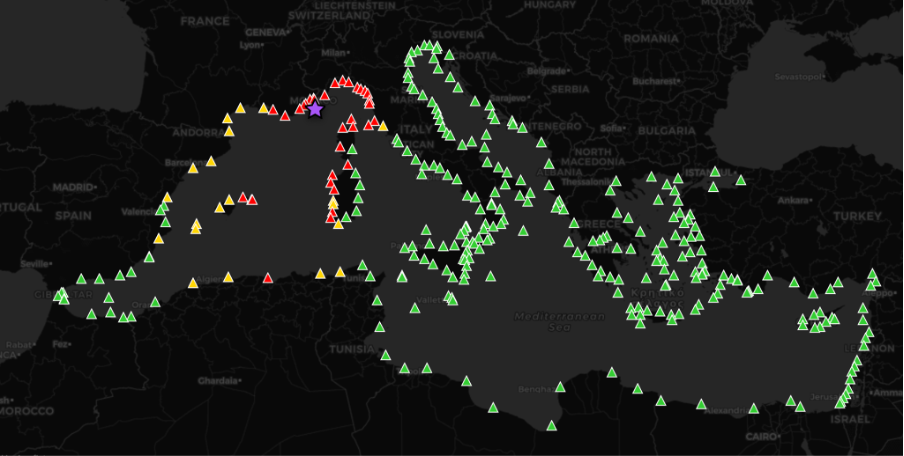
 Figure 1 – Map showing the tsunami alert levels at the Forecast Points (triangles) for the INGV-CENALT scenario of magnitude 6.9 on 5 November 2026; the purple star indicates the location of the epicentre, while the colours associated with the triangles indicate the three tsunami alert levels.
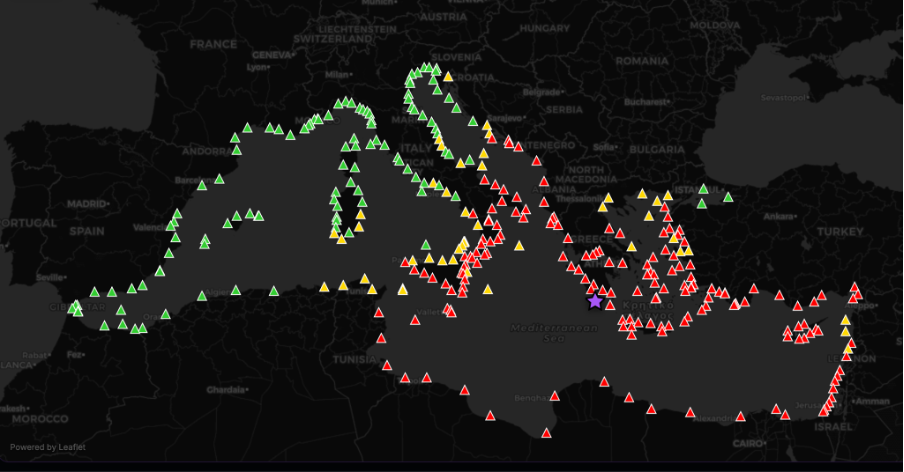 Figure 2 – Map showing the tsunami alert levels at the Forecast Points (triangles) for the INGV-NOA scenario of magnitude 7.9 on 11 November 2026; the purple star indicates the location of the epicentre, while the colours associated with the triangles indicate the three tsunami alert levels.
The NEAMWave26 exercise will take place on 5 and 11 November 2026, involving the INGV Tsunami Alert Centre (CAT-INGV) – accredited as a Tsunami Service Provider (TSP) for the Mediterranean Sea – and the other TSPs in the NEAM region (North-East Atlantic, Mediterranean Sea and connected seas).
This exercise begins on 5 November, the date on which World Tsunami Awareness Day (WTAD 2026) was established. The anniversary provides an important opportunity to promote tsunami risk prevention and awareness, offering the chance for coastal communities to test and improve their emergency response capabilities.
Two test scenarios for NEAMWave26
The CAT-INGV has collaborated with CENALT, the French TSP operating in the western Mediterranean Sea and the North Atlantic Ocean, and with NOA, the Greek TSP operating in the eastern Mediterranean Sea. Two distinct scenarios of potentially tsunamigenic seismic events in the Mediterranean basin have been developed:
- 5 November 2026 (Joint INGV–CENALT scenario): simulation of a magnitude 6.9 earthquake with its epicentre in the Ligurian Sea (Figure 1);
- 11 November 2026 (INGV–NOA joint scenario): simulation of a strong earthquake of magnitude 7.9 with its epicentre off the southern coast of the Peloponnese (Greece, Figure 2).
Both scenarios will trigger alerts along the Italian coastline, simulated using the method recently introduced by CAT-INGV known as ‘Probabilistic Tsunami Forecasting’ (PTF).
Furthermore, the 11 November scenario will involve coastal municipalities participating in the international UNESCO "Tsunami Ready" programme.
The PTF approach behind the exercise
This year’s exercise represents an important opportunity not only to raise awareness of tsunami risk but also to demonstrate, in a simulated context, the effectiveness of a significant methodological innovation recently integrated into CAT-INGV’s operational procedures.
Since 5 October 2026, the CAT-INGV has adopted the PTF, a probabilistic approach to tsunami forecasting which has replaced the traditional and less accurate decision matrix, still used by other TSPs in the Mediterranean.
What is the PTF?
Within minutes of a strong earthquake offshore or near the coast, the PTF enables the probability to be estimated that the intensity of the tsunami will exceed defined thresholds at predefined points along the coasts of the Mediterranean Sea. The PTF integrates initial information regarding the seismic event that has just been recorded with existing seismotectonic knowledge of the area where the earthquake occurred, thereby providing estimates that are, in principle, more accurate than those that could be obtained using the decision matrix previously in use.
The probability values estimated by the PTF are converted into the standard alert levels defined by UNESCO/NEAMTWS:
-
Advisory (Orange): wave heights less than 0.5 metres near the coast (associated with flooding or a run-up of less than 1 metre in the immediate hinterland)
-
Watch (Red): wave heights exceeding 0.5 metres near the coast (associated with flooding or a run-up of more than 1 metre in the immediate hinterland).
To guarantee the highest level of protection for the population, the Department of Civil Protection, with the support of the Tsunami Section of the Major Risks Commission, has decided to adopt a particularly precautionary approach, based on the 98th percentile of the probability distribution. This is a prudent decision that takes into account the significant uncertainties arising from the need to issue a warning as quickly as possible, even with incomplete information, in order to give the public as much time as possible to protect themselves.
For this reason, it is reasonable to expect that, in real-world events – as was the case with the event on 23 October – the alert will subsequently be cancelled without any significant tsunami having occurred; on the other hand, a conservative approach also ensures that, in the majority of cases, an alert is not underestimated when a tsunami has actually been generated.
The earthquake in the Tyrrhenian Sea on 23 October 2026: the PTF in the management of a real-world event
Less than a month after its introduction, the PTF had already been applied in a real-world context when, on 23 October 2026, an earthquake of magnitude Mwp 5.7 occurred in the Tyrrhenian Sea, near the Aeolian Islands (Mwp is the type of magnitude estimator used by CAT-INGV; using other estimators, the INGV published a moment magnitude of 5.5).
Following the precautionary 98th percentile criterion, the CAT-INGV promptly sent an advisory alert to the Department of Civil Protection for the island of Ustica, the Aeolian Islands and certain sections of Sicily’s northern coast (Palermo, Cefalù, Sant’Agata di Militello and Milazzo). The alert was subsequently revoked after approximately one hour, once it had been verified that the data transmitted by the sea-level monitoring stations in the area did not indicate any significant sea-level anomalies.
NEAMWave26 will provide a further opportunity to improve operational procedures and strengthen collaboration between the scientific community, Civil Protection and coastal authorities, helping to make tsunami risk management increasingly timely and effective.
The role of Italian local authorities involved in the UNESCO Tsunami Ready programme within NEAMWave26
The Tsunami Ready programme requires coastal communities worldwide to follow a structured process to adopt the minimum measures necessary to reduce tsunami risk. Once the set objectives have been achieved, the UNESCO Oceanographic Commission awards the ‘Tsunami Ready’ designation to the community that has applied for it. The designation is valid for four years, after which it may be renewed by repeating the procedure.
Building on the experience of previous editions, including that of the municipality of Minturno in 2023, on 11 November – as part of the scenario involving the earthquake in Greece – the exercise will actively involve not only local authorities already recognised as ‘Tsunami Ready’, but also those currently undertaking the accreditation process.
In NEAMWave26, participating municipalities will be asked, first and foremost, to verify the correct receipt of warning messages and the functioning of communication channels. Some of them will expand their participation by simulating additional activities, including:
-
The activation of the procedures set out in municipal civil protection plans.
-
The alert chain following receipt of the message, including communication with the local population.
- Operations and evacuations in the field to safe areas, involving schools, residents and local service providers.
The municipality involved in the 11 of novembre exercise will be Gaeta (LT), Minturno (LT), Palmi (RC), Villa S. Giovanni (RC), Messina.