



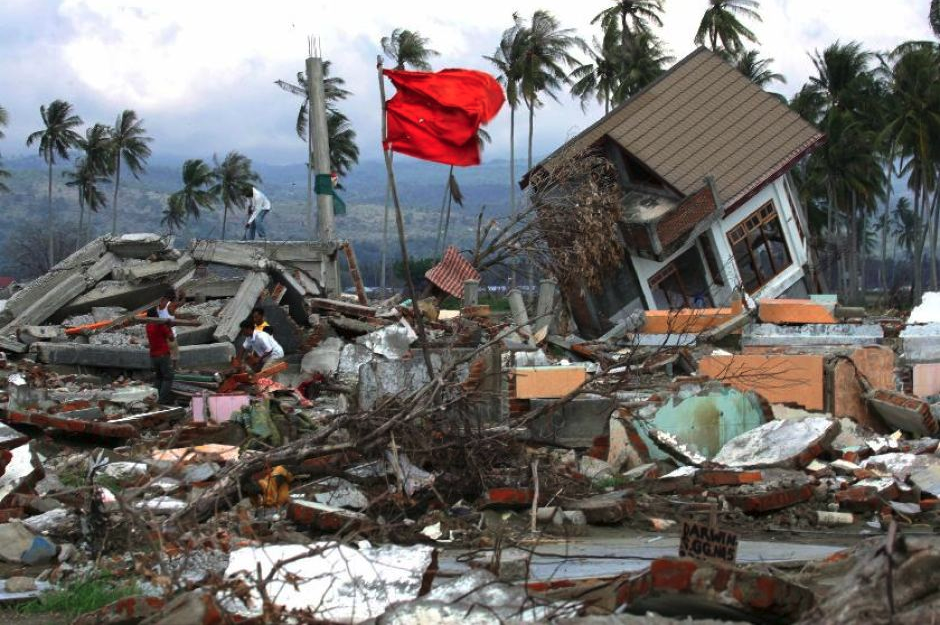
At 7:58 a.m. local time (00:58 UTC) on 26 December 2004, a powerful earthquake hit the Banda Aceh region in Indonesia, marking the beginning of one of the most devastating natural disasters of the last century. The 9.1-magnitude earthquake is one of the strongest earthquakes recorded in the 20th and 21st centuries and was generated by the rupture of a fault more than 1,000 km long, which occurred at the edge of the Indo-Australian plate, which, in subduction, slides under the Burma plate.
Within 20 minutes of the main quake, a catastrophic tsunami initially hit the coasts of northern Indonesia with waves up to 30 metres high and, in the following hours, those of the entire Indian Ocean, causing death and damage even thousands of kilometres away from the epicentre. The tsunami quickly spread throughout the Indian Ocean, reaching dozens of countries along the Asian and African coasts. In Thailand, Sri Lanka, India and the Maldives, the tsunami caused devastation and tens of thousands of deaths, including tourists from all over the world. The waves reached distant Africa where in Somalia - many hours after the earthquake - they caused extensive damage and almost three hundred casualties; many more were recorded in Kenya, Tanzania and South Africa.
Tsunamis of this type, which produce effects of global dimensions reaching even distances greater than 1,000 km from the seismic source as generated by powerful earthquakes, such as the 2004 earthquake, are defined - from the point of view of those who experience the effects - as ‘teletsunamis’. Due to the great distance from the seismic source, the earthquake that generates the tsunami cannot be felt by the population before the first tsunami arrives. In these cases, only those who are aware of phenomena that may precede the arrival of the tsunami can protect themselves. Among the natural signs that anticipate the arrival of a tsunami are A) the retreat of the sea (should it occur; it is possible, in fact, for the first wave to arrive without the retreat of the sea occurring) B) a loud rumble coming from the sea C) the receipt of a tsunami warning. This event in fact highlighted the importance of early warning systems and international collaboration between tsunami centres of expertise and tsunami warning centres, such as the Pacific Tsunami Warning System (PTWS), already operational in 2004 in the Pacific Ocean. At the time, the most affected countries - including Indonesia, Thailand, Sri Lanka and India - lacked an adequate tsunami warning system, leaving the population exposed to the risk. In response, the disaster accelerated the development of regional warning systems, leading to the creation of the North Eastern Atlantic, Mediterranean and connected seas Tsunami Warning and Mitigation System (NEAMTWS) and the INGV Tsunami Alert Centre. In total, the 2004 tsunami killed more than 230,000 people and over 22,000 went missing. The 2004 tsunami can be defined as the tsunami of change as it provided a great boost to the centres of expertise and the entire scientific community for the implementation and improvement:
- of tsunami detection systems (monitoring)
- of tsunami hazard studies using various technologies at 360°: from paleotsunami studies to high-resolution modelling also useful for producing inundation maps and improving evacuation planning
- of studies on local communities to investigate tsunami risk perception, the presence of historical memory of past tsunamis and anthropological traditions to cope with tsunamis (mitigation)
The INGV Tsunami Warning Centre is actively engaged in the above-mentioned activities and, for this occasion, participated in the publication of the Storymap ‘Sumatra 2004. Twenty years after the Indian Ocean tsunami of 26 December 2004' in collaboration with INGVTerremoti preceded by the publication of an Instagram series of stories (in ITA). For the occasion, the head of INGV's Tsunami Alert Centre (Alessandro Amato) was interviewed by Rai Radio3 Scienza in the programme entitled ‘Quelle onde di 20 anni fa’ (in ITA).